

Overview
In the 1970s, Derek Robinson, a marketing executive employed by Boehringer Ingelheim Limited, developed the concept of Migraine Art to articulate the unique power of visual representation in expressing migraine’s symptoms and lived experience. According to Robinson’s formal definition, Migraine Art denotes the idea that techniques of pictorial representational art may provide an adequate and sometimes the best suited medium to express and communicate those experiences which occur as signs and symptoms of migraine or as reactions of the migraine sufferer to the said manifestations of the disease.
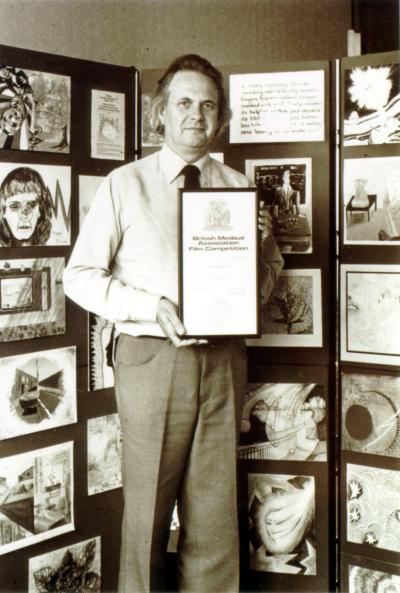
The origins of Robinson’s concept trace to 1973, when he encountered Miss J.R.B., a 42-year-old art teacher living with basilar migraine since childhood. Introduced to her by Dr Kenneth Michael Hay MBE, a Midlands general practitioner, Miss J.R.B. had developed a practice of illustrating her migraine symptoms—both the pain and the visual disturbances of her aura—through sketches and paintings to help her doctor understand the stress her attacks caused. Robinson recognized in her artwork the answer to his search for compelling visual imagery to promote a new antimigraine medication. He incorporated her work into an audiovisual programme that would become the cradle of the Migraine Art concept.
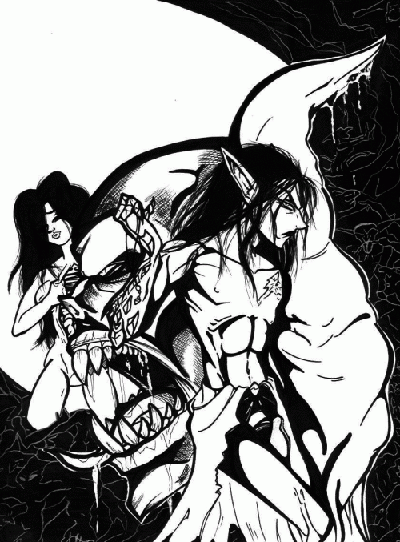
Central to Robinson’s thinking was a deliberate rejection of aesthetic judgment. He employed the term ‘art’ in its most inclusive sense, with no implication of aesthetic evaluation. The concept does not claim that migraine creates a uniquely characteristic art form or that migraineurs as a group produce work distinguished by the causal effects of migraine itself. This position finds support in a quote from painter Jean Dubuffet, whom Robinson cited: “There is no art of the insane any more than the art of the dyspeptics or an art of people with knee complaints.”
Instead, Migraine Art democratizes representation. It invites anyone who has experienced migraine—sufferer or artist, amateur or professional—to translate their symptoms into visual form. The resulting works range from clinical observations commonplace in medical literature to subtle phenomena never before documented. Together, they create what Robinson envisioned as an almost complete pictorial inventory of the symptoms of migraine aura, a testament not to artistic brilliance but to the communicative power of image when words fail.