

Overview
Charles Lutwidge Dodgson, better known as Lewis Carroll, authored Alice’s Adventures in Wonderland (1864) and Through the Looking-Glass (1871)—two of the most imaginative works in English literature. In 1999, neurologist Klaus Podoll and Derek Robinson published research in The Lancet proposing that Carroll’s surreal narratives may have been inspired by his own migraine aura experiences.
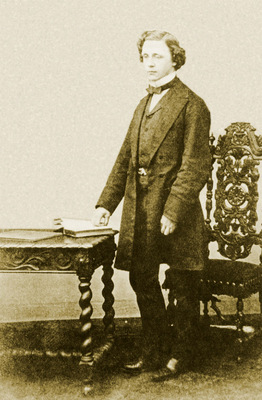
The evidence, though circumstantial, is compelling. Carroll’s 1885 diary entry recorded that he had “experienced, for the second time, that odd optical affection of seeing moving fortifications, followed by a headache”—a clear description of migraine visual aura with its characteristic scintillating patterns. Even more suggestive is a sketch Carroll produced sometime between 1855–1862 in his notebook Mischmasch. The drawing depicts an elf-like figure that is meticulously rendered except for a striking omission: the right side of the face, along with portions of the shoulder, wrist, and hand, are missing—as if obscured by an invisible border. This pattern mirrors a negative scotoma, the visual field defect that occurs in migraine aura where patients cannot see objects within certain regions of their visual space.
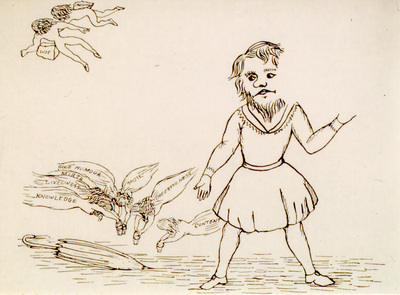
When Carroll consulted the eye specialist Mr. Bowman in January 1856, he made no mention of pain or physical injury. Podoll and Robinson speculate he was seeking an explanation for this peculiar visual phenomenon. The sketch and the medical consultation together suggest that Carroll experienced migraine hallucinations in the years preceding the creation of the Alice books. The recurrence of these aura symptoms over time may explain the elaborate dreamscapes of Wonderland, where Alice drinks potions and magically grows and shrinks, experiences spatial distortions, and encounters the Cheshire Cat’s gradual disappearance—phenomena that echo the peculiar visual transformations of migraine aura.
The Mad Hatter’s distorted perception of time and the altered sense of scale throughout the narrative—“curiouser and curiouser”—align with the symptoms of Alice in Wonderland syndrome (macrosomatognosia and microsomatognosia), the perceptual disturbances that can accompany migraine aura. Carroll thus may have transformed his own neurological experiences into the imaginative fabric of literature, creating works that have captivated readers for generations while serving as an inadvertent documentation of migraine’s subjective reality.