Body Image Disturbances (Alice in Wonderland Syndrome)
Type: Transitory aura symptom — typically develops gradually over 5–20 minutes and resolves within 60 minutes.
What is it?
Body image disturbances are sudden, temporary changes in how you perceive your own body — its size, weight, shape, or position in space. Also called Alice in Wonderland syndrome (named after Lewis Carroll’s novel, inspired by his own migraine experiences), these symptoms can make you feel like parts of your body are growing or shrinking, or that your entire body feels too heavy to move. These are completely sensory distortions; your body itself is not actually changing.
What it feels like
The experience is deeply disorienting and can be frightening. Your hands might suddenly feel like “long skinny dry twigs” rather than your actual hands. Your head or limbs may feel enlarged or shrunken, or you might feel so incredibly heavy that you’re convinced you cannot move. Sometimes the sensation is reversed — you feel tiny or that everything around you is enormous. Some people experience the world as if it’s rushing past them at high speed, or notice that their depth perception feels completely off. These sensations are accompanied by a strange feeling of light-headedness or unreality, and they fade away completely once the aura ends.
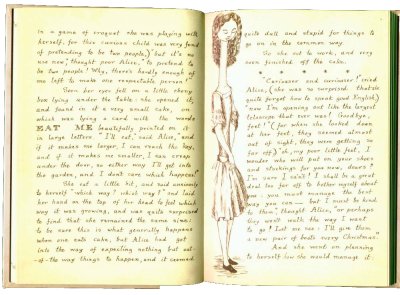 Lewis Carroll’s manuscript of Alice’s Adventures Underground — Carroll’s own migraine experiences are thought to have inspired the story.
 Patient drawing: normal vision, for comparison.
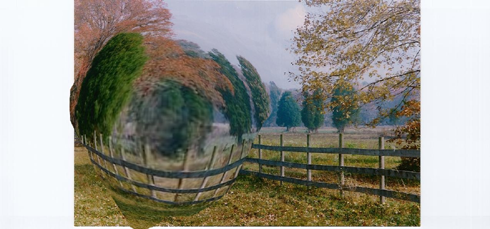 Patient drawing: metamorphopsia in the left half of the visual field, as experienced during migraine aura.
How patients describe it
“I held out my hands in front of me and they didn’t feel like my hands, they felt like long skinny dry twigs. If I concentrate hard enough I can ‘remember’ the feeling and my hands start to feel that way again.” — J.S.
“Most of the time it was when I was sitting still, I would feel so incredibly heavy that I was sure I couldn’t move any part of my body and my depth perception felt like it was completely off. One time while I was walking down the hall I felt like the walls were rushing past me at 50 mph.” — J.S.
“Every episode was accompanied with a strange feeling that at the time I didn’t understand, but in retrospect I would call it an extreme-version of light-headedness, kind of like you’re on laughing gas but highly uncomfortable and very scary.” — J.S.
Subtypes
Macrosomatognosia
The sensation that parts of your body (especially head and upper extremities) are larger than they actually are, sometimes feeling enlarged or bloated.
Microsomatognosia
The opposite sensation — feeling that your body or body parts are smaller than they actually are, or feeling tiny compared to your surroundings.
Out-of-body experiences
Feeling separated or detached from your body, as though you are observing yourself from outside or above your body.
Feeling too heavy
A sensation of extreme weight or heaviness that makes movement feel impossible, even though physical strength is unaffected.
Related symptoms
- Depersonalization or derealization
- Visual illusions or distortions
- Time perception disturbances
- Numbness or tingling sensations
Clinical note
Body image disturbances can be alarming because they are so vivid and foreign to normal experience. However, they are a documented migraine aura symptom and always resolve completely. The symptoms may be more common than realized because people often don’t report them until they learn others experience the same thing. If these symptoms persist beyond an hour or are accompanied by weakness or inability to move that doesn’t resolve, seek medical evaluation to rule out other neurological causes.
If this is the first time you experience these symptoms, or they feel different from previous episodes, seek medical evaluation to rule out other causes.