Other Disturbances of Higher Brain Functions
Type: Transitory aura symptom — typically develops gradually over 5–20 minutes and resolves within 60 minutes.
What is it?
Higher brain functions include color vision, face recognition, and complex visual processing. During a migraine aura, these functions can temporarily malfunction, causing distortions in how you perceive color, faces, or visual information.
What it feels like
You might experience the world in black and white or with color distortions. Familiar faces may temporarily become unrecognizable. Visual scenes may seem glossy or stylized. These experiences can be unsettling but are always temporary and resolve completely.
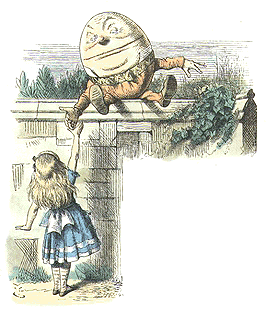 Alice’s encounter with Humpty Dumpty, from Lewis Carroll’s Through the Looking-Glass, 1872. Prosopagnosia — temporary inability to recognise faces — is one of the documented higher cortical disturbances of migraine aura.
How patients describe it
“I thought I did not get aura with my migraines; no seeing stars or sparkly, flashy patterns. But I do - sometimes - get tunnel vision and after that the world seems glossy, stylized, black&white (sometimes) or it gets either very sharp or very fuzzy.” — A.D.
“For me, the first sign of an impending migraine is an inability to recognise faces. At that point I go straight to bed with neurofen (iboprofen) or aspirin in a darken room and can usually sleep through the entire event (about 8 hours).” — P.J.
“Sometimes my surrounding take on an odd orange/yellow color before a migraine strikes.” — M.
Subtypes
Achromatopsia (Loss of Colour Vision)
The world appears in shades of gray or lacks its normal color. This can be accompanied by blurred vision or tunnel vision.
Chromatopsia (Color Distortion)
Colors appear altered or distorted—objects may take on unusual tints like orange, yellow, or other unexpected hues.
Prosopagnosia (Face Blindness)
You temporarily cannot recognize familiar faces, even though you see them clearly. This often includes difficulty understanding spoken language or assembling words correctly.
Allochiria (Sensation Reversal)
Sensations from one side of your body are felt on the opposite side. For example, you might feel pressure in your left hand when touching your right hand.
Balint’s Syndrome (Complex Visual Processing Disorder)
A rare condition affecting how your brain coordinates vision with eye movement and spatial awareness. The world may seem visually fragmented or difficult to navigate.
Related symptoms
- Visual hallucinations
- Scintillating scotoma
- Tunnel vision
- Speech disturbances
Clinical note
These symptoms are characteristic of migraine aura but can occasionally indicate other neurological conditions. If you experience unusual color loss or persistent face-recognition problems, seek medical evaluation to rule out stroke or other serious causes.
If this is the first time you experience these symptoms, or they feel different from previous episodes, seek medical evaluation to rule out other causes.